Why their long-term conviction might be justified by Groww
Signalling stability to groww the market: By holding onto their substantial stake, the founders are signalling to potential public shareholders that they believe in Groww’s future and are keen to stay for the long haul. This can boost investor confidence.
Strong financials ahead of listing: Groww has posted a significant turnaround. It reported revenue of ~₹3,902 crore in FY25, up notably from the prior year, and turned profitable with profit of ~₹1,824 crore. This gives a foundation for confidence.
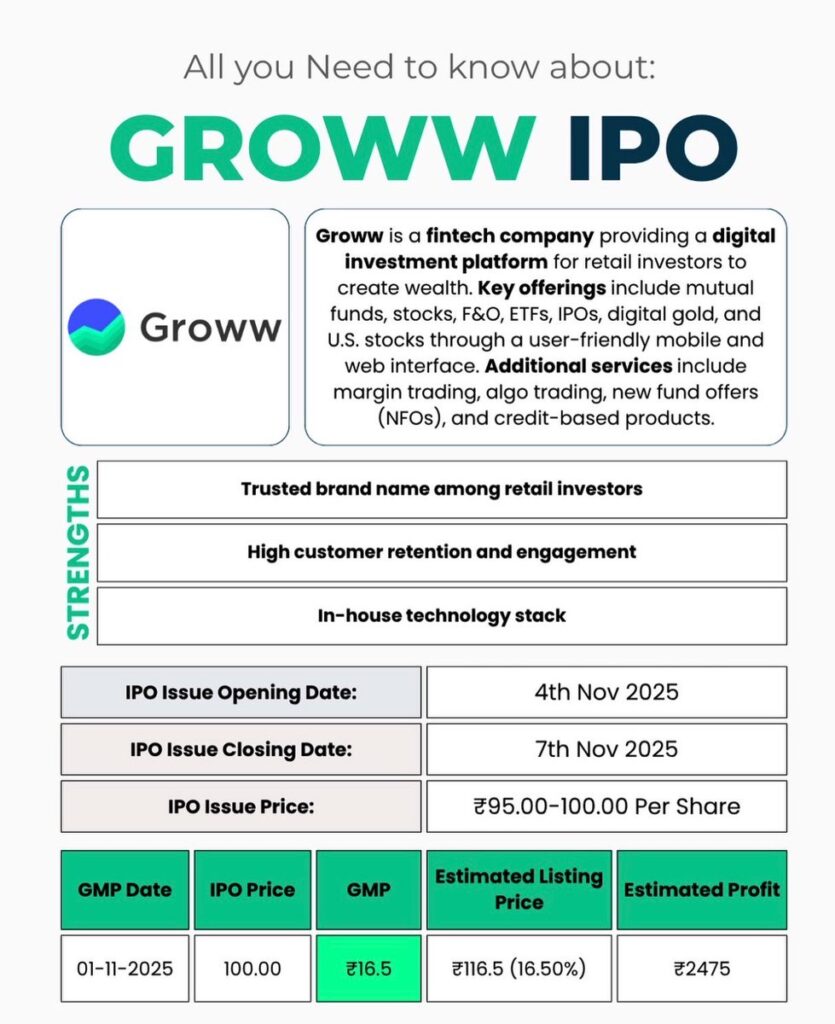
Large remaining ownership: Although the founders have monetised some value via incentives and minor secondary sales, they continue to hold meaningful equity a stake estimated at ~28 % before listing. Maintaining such a stake aligns their interests with public investors.
Growth-oriented business model: Groww operates in a fast-expanding segment retail investing/fintech in India. If they continue to capture market share, the growth potential remains high. Their decision to retain shares implies expectation of upside.
Lock-in & governance constraints: Often, founders face regulatory or lock-in conditions linked to IPOs which restrict share sales for a period after listing meaning staying invested may be both practical and strategic.
Why caution is still warranted
- Incentives and prior monetisation: Although they aren’t selling in the IPO, the founders have already received large one-time incentives and made some secondary sales ahead of the listing. For example, one report notes they received ~₹614 crore in one-time incentives in FY25. This weakens the “zero exit” narrative somewhat—some value has already been realised.
- High expectations baked into valuation: With a strong past year, much of the growth may already be priced in. If future performance lags, the retained shares may not deliver the lofty returns investors hope for.
- Competition & execution risk: The fintech/investing space is crowded and evolving. Growth, user acquisition, retention, and regulatory shifts all bring risks. The founders’ faith is just one piece of the story; execution matters.
- Lock-in might be a factor: The “no shares sold in IPO” stance could partially reflect lock-in agreements rather than purely long-term conviction. One must separate genuine intent from structural constraint.
Groww
I believe their conviction is reasonably justified, but not without caveats. The founders’ decision does tell a positive story: of belief in their company’s future, alignment of interests, and confidence in growth. However, it should not be taken as a guarantee of out-performance. Investors still need to assess how well Groww executes its strategy post-IPO, how competitive pressures play out, and whether growth remains strong.
In other words: it’s a positive signal, but it should be one of several inputs in making an investment decision not the sole reason to invest.