


Election Commission
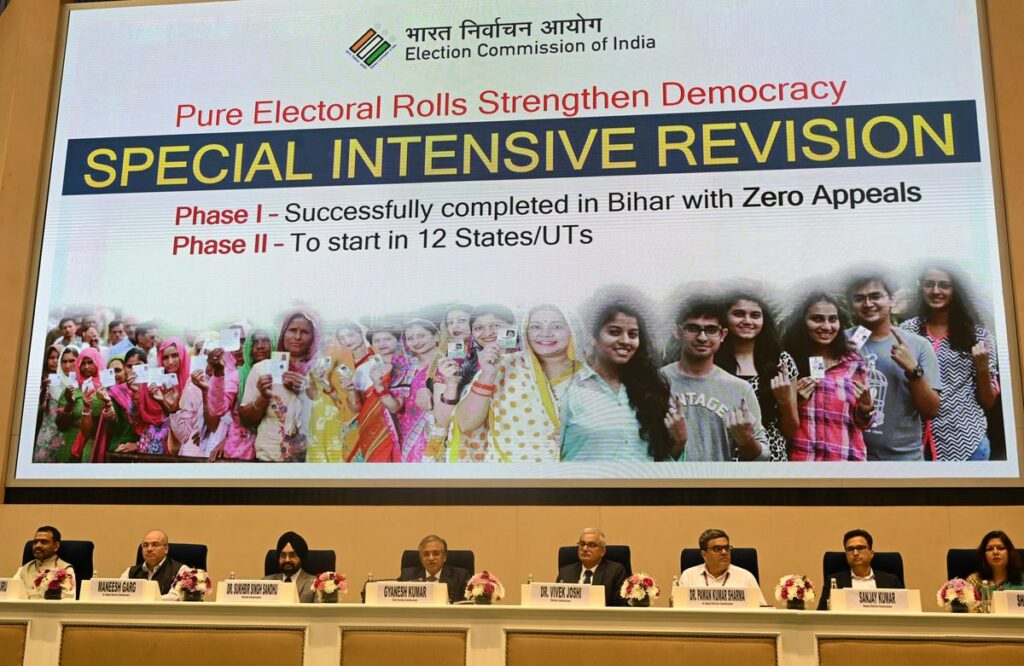
The Election Commission of India has announced a major voter-list revision drive the second phase of its nationwide “Special Intensive Revision” (SIR) exercise covering 12 states and Union Territories beginning 4 November 2025.
What the exercise is about
Under the SIR exercise, the ECI intends to update, verify and purify the electoral rolls so that no eligible voter is left out and no ineligible voter remains. The drive will cover over 51 crore electors across the selected states/UTs.

Where and when
The 12 states/UTs where this phase is being conducted are:
Andaman & Nicobar Islands, Lakshadweep, Chhattisgarh, Goa, Gujarat, Kerala, Madhya Pradesh, Puducherry, Rajasthan, Tamil Nadu, Uttar Pradesh and West Bengal.
- The key timeline:
- Enumeration (house-to-house verification) begins from 4 November 2025 and runs roughly until 4 December 2025.
- Draft electoral rolls to be published on 9 December 2025.
- Period for claims & objections until 8 January 2026.
- Final updated electoral rolls scheduled for publication on 7 February 2026.
Why it matters
This revision is significant because in many of these states the last such large-scale revision was nearly two decades ago (2002-04). By cleaning up voter lists—removing duplicates, deceased persons, or those who have moved away and enrolling newly eligible voters, the ECI aims to enhance the integrity of the electoral process.
Key features & procedural changes
- The qualifying date for inclusion is 1 January 2026: any citizen turning 18 by that date is eligible.
- Unlike earlier revisions, in this round voters do not need to submit documents at the enumeration stage unless they are unlinked to previous records a move to reduce hardship.
- The exercise also addresses concerns of illegal foreign migrants being included in rolls, especially via verifying place of birth and earlier registration.

Potential challenges
While the objective is clear, questions remain over implementation: ensuring that marginalised citizens (migrants, low-income groups) are not inadvertently excluded due to documentation gaps; managing logistic complexity of house-to-house enumeration; and addressing political concerns about the timing of the revision ahead of major elections.
For democratic credibility and voter confidence, this SIR phase can be a game-changer. If you like, I can also pull together the full list of polling-station-wise changes, state-level break-ups, and how voters can self-check their name online.